From Russian For Everyone, some Review Exercises for the various cases:
Showing posts with label nouns. Show all posts
Showing posts with label nouns. Show all posts
Friday, October 19, 2018

Friday, October 5, 2018
Fill Vowels
Fill Vowels are also called Mobile Vowels and Fugitive Vowels. They come and go inside Russian words as they decline or conjugate, so that отец suddenly loses its E and becomes отца, while земля as suddenly gains an E to become земель.
Why? What's going on here?
It's all explainable - if a bit historical and arcane. And it starts with "The Fall of Jers". (And no, "Jers" isn't a city, which was my first thought on hearing the phrase!)
Until roughly a thousand years ago, the Slavic ancestor of Russian had two more vowels – written with the letters ъ and ь, ‘uh’ and ‘ih’ respectively. These very short vowels, which linguists call ‘jers’, eventually suffered the same fate as the final ‘silent e’ in English words like, well, ‘like’ – they stopped being pronounced. Some of them turned into other vowels (mostly O and E) but some simply dropped out of the word entirely. And the ones that remained ceased being vowels entirely and took up their current role as diacritics.
This process - losing these short vowels - meant that Common Slavic, which, up until then, had ended every syllable with a vowel, now had syllables ending in consonants. It also meant that the CC non-syllabic roots came into being. And that is where fill vowels come into play.
For example, take a word like сънъ. Remembering that the ъ was a vowel, this word would have been pronounced ‘suhnuh’. When jers were lost from a word, if there were more than one, the last one, bearing the least stress, was lost; the preceding one was converted to another vowel. So, сънъ became сoн. But in other cases, there was a ‘real’ vowel at the end – genitive сънa – and so it was the other that was lost: сна.
Similarly дьнь became день* and дьня became дня. While in feminine and neuter nouns – with their strong vowel endings – it’s the genitive plural that changes. For instance, сестъра becomes сестра, while сестър became сестер.
The most common fill vowel is O: Examples: ОКНО – ОКОН; ШУТКА – ШУТОК; ОГОНЬ – ОГНЯ Sometimes the O is a Ё: Examples: ЛЁД – ЛДА; СЕСТРА - СЕСТ ЁР; ПА ЁК – ПАЙКА
The next most common fill vowel is a genuine E: Examples: ЧЕЙ – ЧЬЯ; ДЕНЬ – ДНЯ; ЗЕМЛЯ – ЗЕМЕЛЬ; БЕЙ – БЬЮ
И** is more rarely seen.
In adjectives and nouns, it is used only next to a jot. Examples: ТРЕТИЙ – ТРЕТЬЯ; СОБАЧИЙ – СОБАЧЯ; ЯЙЦА – ЯИЦ
In verbs, И is found in imperfectives formed from prefixed perfectives: Еxamples: СОБРАТЬ – СОБИРАТЬ; УМРЕТЬ – УМИРАТЬ; ПОМНИТЬ – ПОМИНАТЬ.
**Note that in six verb roots the fill vowel is Ы:
З/В: ПРИЗВАТЬ – ПРИЗЫВАТЬ
М/К: ЗАМКНУТЬ – ЗАМЫКАТЬ
Р/В: ПОРВАТЬ – ПОРЫВАТЬ
С/Л: ПОСЛАТЬ – ПОСЫЛАТЬ
С/П: ЗАСПАТЬ – ЗАСЫПАТЬ
Т/К: ЗАТКНУТЬ – ЗАТЫКАТЬ
* Remember, the Ь here is marking the final H as soft; it's not a vowel.
Why? What's going on here?
It's all explainable - if a bit historical and arcane. And it starts with "The Fall of Jers". (And no, "Jers" isn't a city, which was my first thought on hearing the phrase!)
Until roughly a thousand years ago, the Slavic ancestor of Russian had two more vowels – written with the letters ъ and ь, ‘uh’ and ‘ih’ respectively. These very short vowels, which linguists call ‘jers’, eventually suffered the same fate as the final ‘silent e’ in English words like, well, ‘like’ – they stopped being pronounced. Some of them turned into other vowels (mostly O and E) but some simply dropped out of the word entirely. And the ones that remained ceased being vowels entirely and took up their current role as diacritics.
This process - losing these short vowels - meant that Common Slavic, which, up until then, had ended every syllable with a vowel, now had syllables ending in consonants. It also meant that the CC non-syllabic roots came into being. And that is where fill vowels come into play.
For example, take a word like сънъ. Remembering that the ъ was a vowel, this word would have been pronounced ‘suhnuh’. When jers were lost from a word, if there were more than one, the last one, bearing the least stress, was lost; the preceding one was converted to another vowel. So, сънъ became сoн. But in other cases, there was a ‘real’ vowel at the end – genitive сънa – and so it was the other that was lost: сна.
Similarly дьнь became день* and дьня became дня. While in feminine and neuter nouns – with their strong vowel endings – it’s the genitive plural that changes. For instance, сестъра becomes сестра, while сестър became сестер.
The most common fill vowel is O: Examples: ОКНО – ОКОН; ШУТКА – ШУТОК; ОГОНЬ – ОГНЯ Sometimes the O is a Ё: Examples: ЛЁД – ЛДА; СЕСТРА - СЕСТ ЁР; ПА ЁК – ПАЙКА
The next most common fill vowel is a genuine E: Examples: ЧЕЙ – ЧЬЯ; ДЕНЬ – ДНЯ; ЗЕМЛЯ – ЗЕМЕЛЬ; БЕЙ – БЬЮ
И** is more rarely seen.
In adjectives and nouns, it is used only next to a jot. Examples: ТРЕТИЙ – ТРЕТЬЯ; СОБАЧИЙ – СОБАЧЯ; ЯЙЦА – ЯИЦ
In verbs, И is found in imperfectives formed from prefixed perfectives: Еxamples: СОБРАТЬ – СОБИРАТЬ; УМРЕТЬ – УМИРАТЬ; ПОМНИТЬ – ПОМИНАТЬ.
**Note that in six verb roots the fill vowel is Ы:
З/В: ПРИЗВАТЬ – ПРИЗЫВАТЬ
М/К: ЗАМКНУТЬ – ЗАМЫКАТЬ
Р/В: ПОРВАТЬ – ПОРЫВАТЬ
С/Л: ПОСЛАТЬ – ПОСЫЛАТЬ
С/П: ЗАСПАТЬ – ЗАСЫПАТЬ
Т/К: ЗАТКНУТЬ – ЗАТЫКАТЬ
* Remember, the Ь here is marking the final H as soft; it's not a vowel.
Thursday, October 4, 2018
Nouns: Case: Dative
Dative case denotes (primarily) the indirect object, that is, the recipient or beneficiary of an action. It answers the questions: кому? чему? to whom? to what?
Major uses of the dative:
1. The person being spoken to, the recipient of the speech (for most verbs of speaking. Exception: verbs of asking, which may be thought of as "I asked a question of John").
Masculine nouns ending in a hard consonant have the ending У. Those ending in a soft consonant (Ь or Й) have the same ending, but it's written Ю (and the Ь or Й is removed: remember - ЬУ and ЙУ are written Ю).
Neuter nouns have the same endings as masculine ones. Hard (ending in O) take У, and soft (ending in E) take Ю.
Feminine nouns have the same endings as they do in Prepositional. So, those ending in A have Е, and those ending in soft signs, or ИЯ, take И and ИИ, as their ending.
Plural is dead easy. Look at the nominative plural. Anything hard (А Ы) takes AM; anything soft (Я И) takes ЯМ.
Singular:
Иван - Ивану
Игорь - Игорю
музей - музею
кресло - креслу
море - морю
здание - зданию
сестра - сестре
песня - песне
история - истории
Plural
Иваны - Иванам
Игори - Игорям
музеи - музеям
кресла - креслам
здания - зданиям
моря - морям
сёстры - сестрам
песня - песням
история - историям
Here is a link to examples of Russian prepositions taking the dative
Major uses of the dative:
1. The person being spoken to, the recipient of the speech (for most verbs of speaking. Exception: verbs of asking, which may be thought of as "I asked a question of John").
- Бабушка читала нам сказки = Grandma used to read us fairy tales.
- Что говорил вам преподаватель? = What did the teacher tell you?
- Я хочу купить Тане книгу = I want to buy Tanya a book.
- Я пишу письмо другу = I am writing my friend a letter.
- Она купила подарок сестре = She bought her sister a present.
- Иван даёт цветы Анне = Ivan gives flowers to Anna.
- Я помогаю Анне = I am helping Anna
- Кате нравится русская музыка = Katya likes Russian music. (Russian music pleases Katya)
- Мне нравится твоё платье = I like your dress.
- Нам холодно = We are cold (to us it's cold)
- Мне скучно = I am bored (to me it's boring)
- Джону трудно говорить по-русски, а Тане легко = It's hard for John to speak Russian, but easy for Tanya.
- Маме надо готовить ужин = Mom has to cook dinner.
- Студентам нужно заниматься = Students have to study.
- Мне восемнадцать лет - I am 18 years old (to me there are 18 years)
- Ивану двадцать три года - Ivan is 23 years old.
- Мы идём к Ивану = We are going to Ivan's.
- Такси подъехало к дому = The taxi pulled up to the house.
- Самолёт летит по небу = A plane is flying across the sky.
- Корабль плывёт по морю = The ship is sailing on the sea.
- Мы встречаемся по средам = We meet Wednesdays.
- Папа дал детям по яблоку = Dad gave the kids an apple apiece.
- Он специалист по металлу = He is a metal specialist.
- Фильм снят по рассказу Чехова = The film is based on a story by Chekhov.
- Заяц съел орех по ошибке = The rabbit ate a nut by mistake.
- Она пропустила лекцию по болезни = She missed class because of illness.
- благодаря им = thanks to them
- согласно ему = according to him/it
- вопреки ей = despite it/her
Masculine nouns ending in a hard consonant have the ending У. Those ending in a soft consonant (Ь or Й) have the same ending, but it's written Ю (and the Ь or Й is removed: remember - ЬУ and ЙУ are written Ю).
Neuter nouns have the same endings as masculine ones. Hard (ending in O) take У, and soft (ending in E) take Ю.
Feminine nouns have the same endings as they do in Prepositional. So, those ending in A have Е, and those ending in soft signs, or ИЯ, take И and ИИ, as their ending.
Plural is dead easy. Look at the nominative plural. Anything hard (А Ы) takes AM; anything soft (Я И) takes ЯМ.
Singular:
Иван - Ивану
Игорь - Игорю
музей - музею
кресло - креслу
море - морю
здание - зданию
сестра - сестре
песня - песне
история - истории
Plural
Иваны - Иванам
Игори - Игорям
музеи - музеям
кресла - креслам
здания - зданиям
моря - морям
сёстры - сестрам
песня - песням
история - историям
Here is a link to examples of Russian prepositions taking the dative
Tuesday, April 17, 2018
Nouns: Plural
The plural form of nouns depends on the gender and singular ending.
Note that some nouns have either no plural (like English "money, help, advice, heroism") or no singular (like English "glasses, trousers, thanks, shenanigans").
Examples include брюки очки железо молодëжь trousers, eyeglasses, iron, youth (young people)
Things to remember:
школа школы
ракета ракеты
трактор тракторы
стол столы
собака собаки
чай чаи
герой герои
врач врачи
1a. Some masculine nouns take А as their ending. These include the same ones with the special locative (У), but also others, including a small number of nouns denoting professions. In colloquial spoken Russian, other professions may also have the A ending.
лес лесa
край края
берег берегa
доктор докторa
учитель учителя
1b. Masculine and feminine nouns ending in Ь take И, replacing the soft sign (basically an application of regular spelling):
ночь ночи
дождь дожди
мышь мыши
3. Neuter nouns ending in O take A; those ending in E take Я.
письмо письма
лето лета
море моря
право права
поле поля
здание здания
окно окна
3. Fleeting (mobile or fugitive) vowels disappearing from masculine nouns:
отец отцы
день дни
4. A few nouns add an infix before the plural ending. In some nouns (like небо - небеса or сын - сыновья) this is only present in plural forms; in some (like мать - матери or имя - имени) it is in all but nominative singular.
4a. Regular patterns include all nouns ending in -анин (dweller in) or -ëнок (young/offspring):
англичанин англичане
гражданин граждане
ребëнок ребята
котëнок котята
5. Some few nouns have quite irregular plurals, like друг - друзья or лист - листья.
---------------------------
Downloadable files:
Note that some nouns have either no plural (like English "money, help, advice, heroism") or no singular (like English "glasses, trousers, thanks, shenanigans").
Examples include брюки очки железо молодëжь trousers, eyeglasses, iron, youth (young people)
Things to remember:
- those ending in ИЙ and adding Ы will spell it ИИ: герой - герои
- nouns ending in ИЯ really end in ИЙА, and thus take ИИ: армия - армии
- after the velars and most hushers (К Г Х Ж Ш Ч Щ, though not Ц) you can't write Ы, so nouns ending in those will have И
школа школы
ракета ракеты
трактор тракторы
стол столы
собака собаки
чай чаи
герой герои
врач врачи
1a. Some masculine nouns take А as their ending. These include the same ones with the special locative (У), but also others, including a small number of nouns denoting professions. In colloquial spoken Russian, other professions may also have the A ending.
лес лесa
край края
берег берегa
доктор докторa
учитель учителя
1b. Masculine and feminine nouns ending in Ь take И, replacing the soft sign (basically an application of regular spelling):
ночь ночи
дождь дожди
мышь мыши
3. Neuter nouns ending in O take A; those ending in E take Я.
письмо письма
лето лета
море моря
право права
поле поля
здание здания
окно окна
3. Fleeting (mobile or fugitive) vowels disappearing from masculine nouns:
отец отцы
день дни
4. A few nouns add an infix before the plural ending. In some nouns (like небо - небеса or сын - сыновья) this is only present in plural forms; in some (like мать - матери or имя - имени) it is in all but nominative singular.
4a. Regular patterns include all nouns ending in -анин (dweller in) or -ëнок (young/offspring):
англичанин англичане
гражданин граждане
ребëнок ребята
котëнок котята
5. Some few nouns have quite irregular plurals, like друг - друзья or лист - листья.
---------------------------
Downloadable files:
Tuesday, April 3, 2018
Noun Declension Types
Some Russian grammarians don't talk of "masculine declension" or "feminine declension", but rather of (like Latin) First, Second, and Third Declensions.
One advantage to this is that declension types are now more independent of gender. All nouns ending in a hard consonant, Й, О or Е are in First Declension. All nouns ending in А or Я are in Second Declension. Only with nouns ending in Ь does gender matter; masculine ones are First and feminine are Third.
Also with this system, the handful of nouns that are truly odd (those neuters ending in МЯ and the nouns Мать, Дочь, Путь, and Дитя) are simply categorized by themselves.
Some learners prefer this system. If so, here are downloadable charts from I.M. Pulkina's A Short Russian Reference Grammar:
One advantage to this is that declension types are now more independent of gender. All nouns ending in a hard consonant, Й, О or Е are in First Declension. All nouns ending in А or Я are in Second Declension. Only with nouns ending in Ь does gender matter; masculine ones are First and feminine are Third.
Also with this system, the handful of nouns that are truly odd (those neuters ending in МЯ and the nouns Мать, Дочь, Путь, and Дитя) are simply categorized by themselves.
Some learners prefer this system. If so, here are downloadable charts from I.M. Pulkina's A Short Russian Reference Grammar:
- First Declension
- First Declension nouns with У genitives - Rules for Use
- First Declension nouns with У locatives (special prepositional) - List of nouns
- Second and Third Declensions
- Peculiarities in the Plural
- Special Declensions (-МЯ, Мать, Дочь, Путь, and Дитя)
Monday, March 19, 2018
Nouns: Cases: Accusative
Accusative case is (primarily) the object of action – what we call “the direct object”. It answers the questions: кого? что? whom? what?
It is also used for other things, mainly:
1. The “accusative of time” is used, often without a preposition to express duration or frequency.
For neuter nouns and inanimate masculine nouns, the accusative is the same as the nominative. (Note: neuter animate nouns are indeclinable; that’s why they don’t have a special case ending. They (preview of coming attractions!) will take animate-type adjective endings.)
Я вижу сад = I see a garden.
Я вижу лес = I see the woods.
Я вижу музей = I see a museum.
Я вижу рубль = I see a ruble.
Feminine and masculine nouns ending in A or Я take У or Ю for their accusative case ending. Those ending in Ь do not change.
Я вижу папу = I see Daddy.
Я вижу улыцу = I see the street.
Я вижу армию = I see an army.
Я вижу мать = I see the mother.
Animate masculine nouns take A or Я for their ending, depending on whether the consonant they end in is hard (A) or soft (Ь and Й are replaced by Я, or, more accurately, Й/Ь + А = Я). This is actually the same ending as the genitive case, which we haven't met yet; you're getting a leg up here: inanimate masculines have the same genitive forms.
Я вижу героя = I see a hero.
Я вижу Андрея = I see Andrey.
Я вижу коня = I see a horse.
Я вижу человека = I see a person.
Я вижу Путина = I see Putin.
Here are the covers of two books written by Andrey Kolesnikov about Putin's first two presidential terms. Note that only case endings differentiate the titles - the word order is the same.
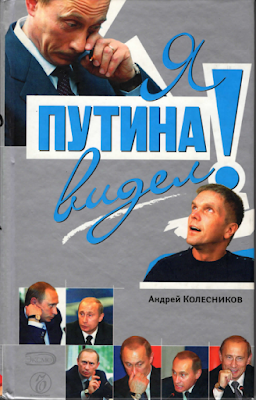
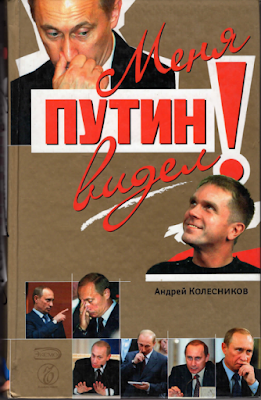
It is also used for other things, mainly:
1. The “accusative of time” is used, often without a preposition to express duration or frequency.
- Я здесь уже неделю = I've been here (for) a week.
- Раз в год = Once a year
- Мы едем в Москву. = We're going to Moscow.
- Мы идëм в музей. = We're going to the museum.
- Мы идëм через лес. = We're walking through the woods.
- Мы идëм через улыцу. = We're going across the street.
- Спасибо за письмо. = Thanks for the letter.
- Cколько получает писатель за книгу? = How much does the author get for a book?
- Я – за Путина! = I'm for Putin!
For neuter nouns and inanimate masculine nouns, the accusative is the same as the nominative. (Note: neuter animate nouns are indeclinable; that’s why they don’t have a special case ending. They (preview of coming attractions!) will take animate-type adjective endings.)
Я вижу сад = I see a garden.
Я вижу лес = I see the woods.
Я вижу музей = I see a museum.
Я вижу рубль = I see a ruble.
Feminine and masculine nouns ending in A or Я take У or Ю for their accusative case ending. Those ending in Ь do not change.
Я вижу папу = I see Daddy.
Я вижу улыцу = I see the street.
Я вижу армию = I see an army.
Я вижу мать = I see the mother.
Animate masculine nouns take A or Я for their ending, depending on whether the consonant they end in is hard (A) or soft (Ь and Й are replaced by Я, or, more accurately, Й/Ь + А = Я). This is actually the same ending as the genitive case, which we haven't met yet; you're getting a leg up here: inanimate masculines have the same genitive forms.
Я вижу героя = I see a hero.
Я вижу Андрея = I see Andrey.
Я вижу коня = I see a horse.
Я вижу человека = I see a person.
Я вижу Путина = I see Putin.
Here are the covers of two books written by Andrey Kolesnikov about Putin's first two presidential terms. Note that only case endings differentiate the titles - the word order is the same.


Wednesday, March 14, 2018
Nouns: Cases: Prepositional
The prepositional case (in English, the "object case" is used here) follows (some) prepositions and basically names the place where actions occur. (Thus, an alternate name some resources may use is locative case.)
Prepositional case answers the questions: о ком? о чëм? где? about whom? about what? where?
In Russian grammar books, when there is a table of case endings, prepositional is always shown with O, because this case must follow a preposition.
(See here for discussion of prepositions)
Prepositional case is introduced early in our book because it's so easy. There are only two* endings, И and Е, and the rules for which are simple and as close to being without exceptions as Russian gets. There's no consideration of animacy and only ten nouns where gender matters; it's all about the way the noun ends.
1. Does it end in ИЙ, ИЕ, or ИЯ? Then replace the final letter with И:
3. Is it a neuter noun ending in МЯ? (This is the trickiest, but you'll get used to these nouns and their infix.) Then replace the Я with ЕНИ.
* Okay, actually there are three. (You didn't really think it was going to be that easy, did you?) Due to an historical quirk, some masculine (mostly) one-syllable nouns (or compounds with them) have a different ending in the locative (which is why O is used in grammar tables and charts). These nouns are -E with о, при, and по, about, under (of time), and along. But with в and на, in and on, they have the ending -У:
Prepositional case answers the questions: о ком? о чëм? где? about whom? about what? where?
In Russian grammar books, when there is a table of case endings, prepositional is always shown with O, because this case must follow a preposition.
(See here for discussion of prepositions)
Prepositional case is introduced early in our book because it's so easy. There are only two* endings, И and Е, and the rules for which are simple and as close to being without exceptions as Russian gets. There's no consideration of animacy and only ten nouns where gender matters; it's all about the way the noun ends.
1. Does it end in ИЙ, ИЕ, or ИЯ? Then replace the final letter with И:
санаторий о санатории about the clinic2. Does it end in Ь? Then replace the Ь with И:
здание о здании about the building
армия об армии about the army
ночь о ночи about the night(Note: the -EP- infix shows up in all oblique cases (i.e., all but nominative singular) of both мать and дочь (so o дочери).)
день о дне about the day
мать о матери about a mother
3. Is it a neuter noun ending in МЯ? (This is the trickiest, but you'll get used to these nouns and their infix.) Then replace the Я with ЕНИ.
имя об имени about the name4. Anything else? Replace any final vowel with E and add E to final consonants. Two spelling notes: Й plus E is just E, so the Й vanishes, and yes, words ending in E have the same form as their nominatives.
брат о брате about the brother
чай о чае about tea
герой o герое about a hero
папа о папе about Dad
сад o садe about the garden
окно об окне about a window
море о море about the sea
вода о воде about water
* Okay, actually there are three. (You didn't really think it was going to be that easy, did you?) Due to an historical quirk, some masculine (mostly) one-syllable nouns (or compounds with them) have a different ending in the locative (which is why O is used in grammar tables and charts). These nouns are -E with о, при, and по, about, under (of time), and along. But with в and на, in and on, they have the ending -У:
сад garden o садe but в саду in the garden
день day о дне but на дню on the day
порт port o портe but в порту in the port
край edge о крае but на краю at the edge
берег shore о береге but на берегу on the shore
аэропорт airport o аэропортe but в аэропорту at the airport
Monday, March 12, 2018
Nouns: Animacy
The Russian for animate noun is одушевлённое существительное. The word одушевлённое literally means ‘ensouled’, but it’s not that simple (of course!).
Animacy is a grammatical category consisting (mostly) of living things. However, some things that are not alive are nonetheless animate, and plants, though alive, are not animate. Collective nouns, even referring to groups of people, are not animate.
It is most noticeable (or applicable) to grammatically masculine nouns. It also applies to feminine and neuter nouns, but only a handful of neuters, and only in plural for feminines.
An animacy Venn diagram: a = animate, b = inanimate, and c may be either:

Some nouns that are unexpectedly animate:
Now: the $64,000 question: Why does this even exist? There's actually a very good semantic reason behind it.
Because Russian word order lets the direct object be in front of the verb and the subject behind it, sentences such as “man bites dog” would be ambiguous if there were not a grammatical way to tell the cases apart. Animacy is that way.
Since masculine accusative has the same ending as nominative, masculine and neuter animate nouns take the same ending as genitive in the accusative. This allows for the subject and object to be clearly marked. Inanimate nouns generally can't be confused for the subject - a cat may look at a king, but a table cannot. Feminine nouns, of course, already have a different accusative ending.
Some examples:
With neuter:
Things are more straightforward with feminine nouns, as they generally have the У ending in accusative, which is different from both nominative and genitive.
Женщина видит книгу = the woman sees a book
However, when both subject and object are feminine nouns in –Ь, there is ambiguity. Who loves whom in this sentence: Мать любит дочь? Here (and only here) does Russian rigidly adhere to SVO word order: the mother loves the daughter, and never the other way around.
But what if you want to reverse the word order? You'd think they'd use genitive endings, but they don't. In fact, this is a good sign that nothing is "planned" in language. Instead, the workaround is to use a modifier, which shows the case endings:
Animacy is a grammatical category consisting (mostly) of living things. However, some things that are not alive are nonetheless animate, and plants, though alive, are not animate. Collective nouns, even referring to groups of people, are not animate.
It is most noticeable (or applicable) to grammatically masculine nouns. It also applies to feminine and neuter nouns, but only a handful of neuters, and only in plural for feminines.
An animacy Venn diagram: a = animate, b = inanimate, and c may be either:

Some nouns that are unexpectedly animate:
- some words for dead people: покойник and мертвец (dead man) are animate, while труп (corpse) is inanimate
- the word лицо when meaning “individual” (but not “face”, its main meaning)
- things appearing human, such as робот (robot), чудовище (monster) пугало (scarecrow), снеговик (snowman)
- games, such as куклы (dolls)
- court cards, like туз (ace) and валет (jack)
- chess pieces, like ферзь (queen [vizier]) and слон (bishop [elephant])
- little living things, like микроб (microbe), личинка (maggot), бактерия (bacterium), зародыш (fetus), эмбрион (embryo); this is dependent on the speaker's attitude.
- non-mammals that are eaten, like устрицы (oysters) or креветки (shrimp), are animate if being talked about as animals but inanimate if being talked about as food.
Now: the $64,000 question: Why does this even exist? There's actually a very good semantic reason behind it.
Because Russian word order lets the direct object be in front of the verb and the subject behind it, sentences such as “man bites dog” would be ambiguous if there were not a grammatical way to tell the cases apart. Animacy is that way.
Since masculine accusative has the same ending as nominative, masculine and neuter animate nouns take the same ending as genitive in the accusative. This allows for the subject and object to be clearly marked. Inanimate nouns generally can't be confused for the subject - a cat may look at a king, but a table cannot. Feminine nouns, of course, already have a different accusative ending.
Some examples:
- Человек видит кота = the person sees a cat
- Кота видит человек = the person sees a cat
- Человека видит кот = the cat sees a person
- Кот видит человека = the cat sees a person
With neuter:
- Человек видит чудовища = the person sees a monster
- Чудовища видит человек = the person sees a monster
- Человека видит чудовище = the monster sees a person
- Чудовище видит человека = the monster sees a person
Things are more straightforward with feminine nouns, as they generally have the У ending in accusative, which is different from both nominative and genitive.
Женщина видит книгу = the woman sees a book
However, when both subject and object are feminine nouns in –Ь, there is ambiguity. Who loves whom in this sentence: Мать любит дочь? Here (and only here) does Russian rigidly adhere to SVO word order: the mother loves the daughter, and never the other way around.
But what if you want to reverse the word order? You'd think they'd use genitive endings, but they don't. In fact, this is a good sign that nothing is "planned" in language. Instead, the workaround is to use a modifier, which shows the case endings:
- Свою мать любит дочь
- Мать любит свою дочь
Wednesday, February 28, 2018
Nouns: Case
First things first: If you don't already speak an inflected language (such as Latin or German), go to the Russian Language Mentor and read Fundamentals of Case Grammar. This will give you a better understanding of what's going on when Russian inflects for case.
Russian has six cases, answering six general questions:
Notice that in English, 'whom' declines but 'what' doesn't, and that 'whom' has only two declined forms. That's pretty much the case across the board. English nouns only change to show possession. Pronouns also change when used as objects - that is, some of them do.
Now, on to the case forms.
The dictionary form of the noun, the one you will learn in vocabulary lists and such, is the nominative case. (In English, this is often called "the subject(ive) case".) All subjects and all predicate nominatives are in nominative case. It is the basic form, the one all other forms change from.
The patterns of a noun's changing are called its declension. Generally, people say the endings are added to the noun; in practice, this is true for masculine nouns, but feminine and neuter nouns have their endings changed.
As an example, the full set for masculine стол table and feminine книга book:
стол стола стола столу столом столе столы столов столы столам столами столах
книга книги книгу книге книгой книге книги книг книги книгам книгами книгах
Note how the -a from книга disappears and is replaced by the other endings. (Don't fear! We will go into all the cases and their endings.)
Posts by Case:
Prepositional:
Resources
Here is a web application that will provide all the forms of a noun you provide.
These language learning sites will have units on noun cases: Master Russian, Russian Nouns and Cases.
From Learning Russian,Nouns and Cases.
From Russian Lessons, Summary of the Cases with more details at links provided.
Russian has six cases, answering six general questions:
| Case Name | English name | Function | Questions |
|---|---|---|---|
| Nominative | Subject | actor or agent, doer | Who? What? |
| Genitive | Possessive | possessor | Of whom, whose? Of what? |
| Accusative | Objective | object, one/thing done to | Whom? What? |
| Dative | Objective | indirect object, recipient | To whom? To what? |
| Instrumental | Objective | accompaniment, thing used | With/by whom? With/by what? |
| Prepositional | Objective | location, thing talked about | About whom? About what? Where? |
Notice that in English, 'whom' declines but 'what' doesn't, and that 'whom' has only two declined forms. That's pretty much the case across the board. English nouns only change to show possession. Pronouns also change when used as objects - that is, some of them do.
Now, on to the case forms.
The dictionary form of the noun, the one you will learn in vocabulary lists and such, is the nominative case. (In English, this is often called "the subject(ive) case".) All subjects and all predicate nominatives are in nominative case. It is the basic form, the one all other forms change from.
The patterns of a noun's changing are called its declension. Generally, people say the endings are added to the noun; in practice, this is true for masculine nouns, but feminine and neuter nouns have their endings changed.
As an example, the full set for masculine стол table and feminine книга book:
стол стола стола столу столом столе столы столов столы столам столами столах
книга книги книгу книге книгой книге книги книг книги книгам книгами книгах
Note how the -a from книга disappears and is replaced by the other endings. (Don't fear! We will go into all the cases and their endings.)
Posts by Case:
Prepositional:
Resources
Here is a web application that will provide all the forms of a noun you provide.
These language learning sites will have units on noun cases: Master Russian, Russian Nouns and Cases.
From Learning Russian,Nouns and Cases.
From Russian Lessons, Summary of the Cases with more details at links provided.
Nouns: Gender
In brief, in Russian, as with many other European languages, each noun is assigned a gender. Russian has three genders: masculine, feminine, and neuter (neutral).
In the cases of words like “father” these relate to physical gender. In the case of other objects like “pen”, “cup”, “house”, there is no physical meaning attached to the gender. However you will still need to know the gender because it affects how words are formed, what endings adjectives use with them, what endings they themselves take in various cases, and which verb forms they govern.
Luckily, unlike many languages, in Russian it is almost always possible to tell what the gender of a noun by its spelling. When you use a noun as the subject of a sentence, it will be in its dictionary form (nominative case). In this form you can easily work out its gender. If the noun is in another part of the sentence the ending is changed to suit the case.
From the dictionary form of a noun, here is how you can tell what the gender is:
Look at the last letter of the word:
Some examples:
Other resources:
Here's the PowerPoint I showed in class.
From Master Russian, Noun number and gender.
From Learning Russian,, Russian gender.
Wikipedia on Russian nouns
From Russian for Everyone, gender of nouns explaining hard and soft stems.
In the cases of words like “father” these relate to physical gender. In the case of other objects like “pen”, “cup”, “house”, there is no physical meaning attached to the gender. However you will still need to know the gender because it affects how words are formed, what endings adjectives use with them, what endings they themselves take in various cases, and which verb forms they govern.
Luckily, unlike many languages, in Russian it is almost always possible to tell what the gender of a noun by its spelling. When you use a noun as the subject of a sentence, it will be in its dictionary form (nominative case). In this form you can easily work out its gender. If the noun is in another part of the sentence the ending is changed to suit the case.
From the dictionary form of a noun, here is how you can tell what the gender is:
Look at the last letter of the word:
- If it is a hard consonant, or “й”, the word is masculine.
- If it is “а” or “я” it is feminine unless denoting a male person, e.g. папа daddy, дядя uncle, дедушка grandfather, мужчина man
- Note: a number of nouns ending in “a” and referring to people are “common gender”, taking masculine or feminine adjectives and verbs as required, e.g. левша left-handed person, сирота orphan
- If it is “о” or “е” it is neuter except for кофе coffee, and borrowed words naming animals, e.g. шимпанзе, chimpanzee
- If it is a soft sign “ь” then it could be either masculine or feminine. This is the biggest source of confusion, but there are still some guidelines.
- Natural gender: Male living things are masculine, e.g. зять son-in-law, кобель male dog, король king, парень young man, lad
- All month names are masculine, e.g. январь January февраль February
- All birds and insects are masculine except выпь bittern, неясить tawny owl, and моль moth
- Suffixes that are masculine: -тель ‘deverbal agent’, i.e., one who or that which does (-er) учитель teacher, двигатель engine (one which moves) and -арь ‘one who is or does’ вратарь goalkeeper, пекарь baker
- Suffixes that are feminine: -ель (not –тель) from verbs гибель death, ruin метель snow storm (this is from a verb root мет) and -ость abstract nouns (like English –ness) милость kindness, внимательность carefulness
- See slides (linked below) for more
- If it is “у” it is neuter unless naming an animal, when it is masculine, e.g. какаду cockatoo.
Some examples:
- Masculine : паспорт passport, документ document, брат brother, хлеб bread.
- Feminine : газета newspaper, Россия Russia, дочь daughter
- Neuter : здание building, радио radio, письмо letter
Other resources:
Here's the PowerPoint I showed in class.
From Master Russian, Noun number and gender.
From Learning Russian,, Russian gender.
Wikipedia on Russian nouns
From Russian for Everyone, gender of nouns explaining hard and soft stems.
Subscribe to:
Posts (Atom)
-
Fill Vowels are also called Mobile Vowels and Fugitive Vowels. They come and go inside Russian words as they decline or conjugate, so that о...
-
 The Russian for animate noun is одушевлённое существительное. The word одушевлённое literally means ‘ensouled’, but it’s not that simple (...
 -
The plural form of nouns depends on the gender and singular ending. Note that some nouns have either no plural (like English "money, h...